


 Guidé Village, Chuiyang, Aojiang Town, Pingyang County, Wenzhou City, Zhejiang Province, China

 English
 Español
 عربى
عربى 中文简体
中文简体
Woven Bag Packaging for Cartons: Woven Bag Size and Process Selection
Date:Sep 11, 2026
Anyone who has dealt with export cartons knows the woven bag is doing more work than it gets credit for. It takes the abrasion from container floors, the friction from stacking, and the abuse of forklift handling — all while the carton underneath stays intact. Getting the size wrong means either wasted PP Woven Bags material and inflated freight cost, or a bag that's too tight to close properly and tears at the seams. This guide walks through the sizing formula suppliers actually use on the factory floor, plus how to pick between standard woven, Laminated Woven Bags, BOPP Laminated Woven Bag, and PP Laminated Kraft Paper Bag constructions depending on the shipping route and end client's needs.
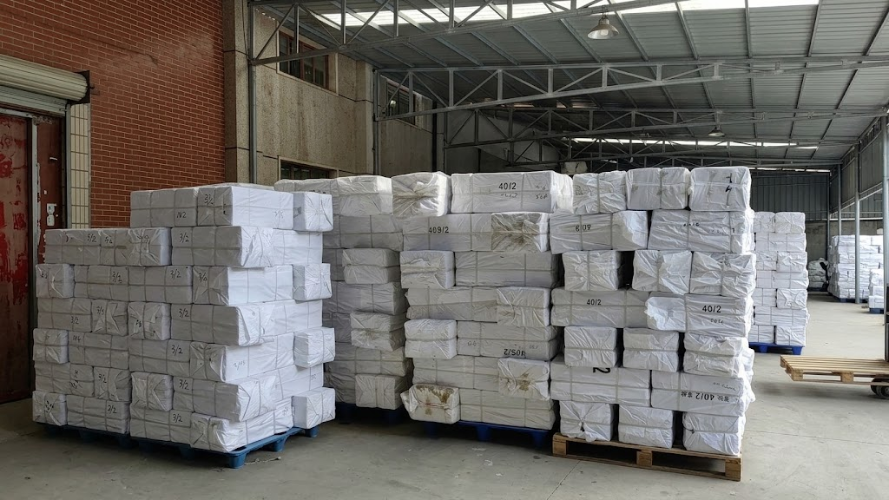
1. Steps for Wrapping a Carton with a Woven Bag
There's a reason this process follows a fixed order — skip a step and you end up with a bag that shifts during loading or doesn't seal properly at all.
1. Pack the carton fully and tape it shut before anything touches the woven bag.
2. Take length, width, and height measurements, building in a small margin for compression and shifting that happens once the pallet is stacked and moving.
3. Cross-reference those measurements against available bag sizes.
4. Slide the carton into the bag — this sounds obvious, but a snug bag that's off by even a few centimeters won't slide on without forcing the seams.
5. Cinch the opening with rope or tape tight enough that vibration during transit won't work it loose.
2. What Size of PP Woven Bags Should Be Used for a Carton?
It is crucial to select the appropriate woven bag size based on the actual dimensions of the carton.
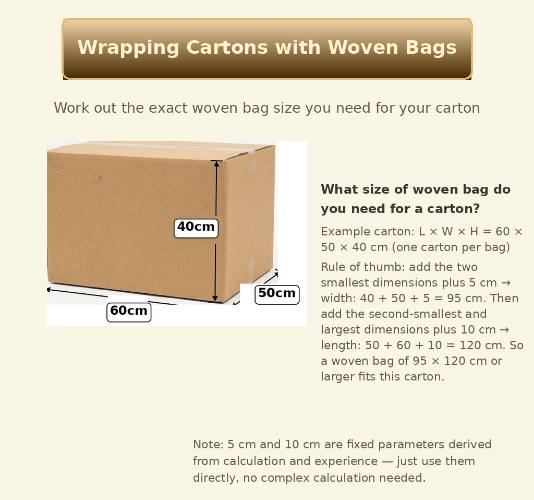
For a carton where L > W > H (cm):
| Bag Dimension | Formula | Logic |
|---|---|---|
| Width (W1) | W + H + 5 | Sum of the two smaller sides, plus clearance |
| Length (L1) | W + L + 10 | Second-largest plus largest side, plus clearance |
Worked example — carton at 60 × 50 × 40 cm:
- W1 = 40 + 50 + 5 = 95 cm
- L1 = 50 + 60 + 10 = 120 cm
A 95 × 120 cm bag, or the next size up, fits this carton without leaving excess fabric bunched at the opening.
One thing procurement teams should flag with their supplier upfront: bag width typically ships in 5 cm increments, so a calculated width of 92 cm still means ordering a 95 cm bag. Factor that rounding into cost estimates rather than assuming exact-match pricing.
3. How to Choose the Woven Bag Construction (Process)?
Size gets the fit right. Construction is what determines whether the cargo survives three weeks at sea or a rough truck route without the packaging failing. Beyond carton and bag dimensions, transportation conditions and customer requirements are what actually drive this decision.
Load Capacity for Heavier Cartons
Heavier cartons need load capacity, not just fabric weight on paper. Standard PP Woven Bags built with a tighter weave and higher denier handle the compression and friction of stacking without breaking or tearing mid-transit. This plain woven construction remains the go-to choice for general cargo where moisture isn't a major concern — durable, cost-efficient, and straightforward to source.
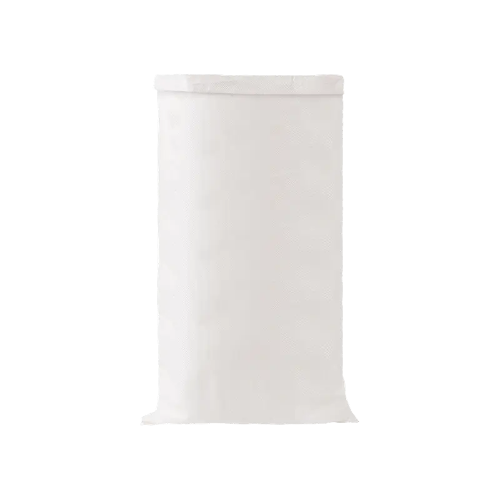
Moisture Protection for Humid or Ocean Transit
Prolonged sea freight introduces a variable land shipping doesn't deal with as often: condensation building up inside containers as they cross temperature zones. Standard woven fabric is breathable, which sounds fine until humidity starts wicking through to the carton. Laminated Woven Bags solve this with a bonded polymer film that blocks moisture transfer and keeps cartons from warping over a multi-week voyage. BOPP Laminated Woven Bag construction has become a common specification here, since the biaxially oriented film adds tear resistance on top of the moisture barrier itself.
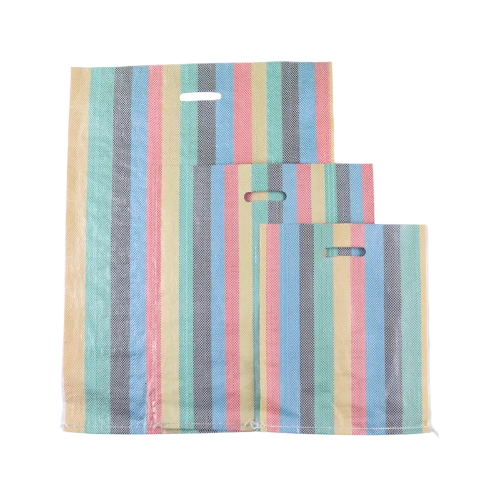
Printed Bags for Handling Instructions and Warnings
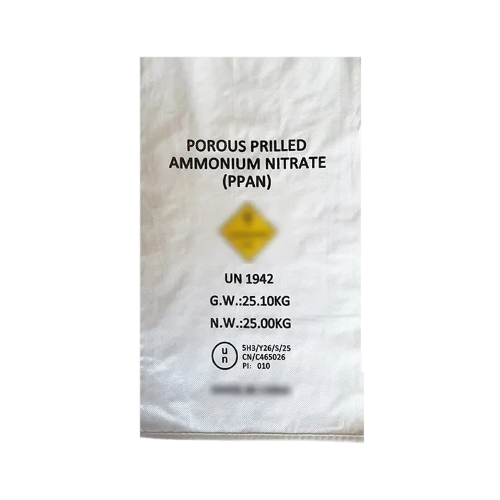
When the only requirement on the bag is something like "This Side Up," a fragile warning, or a basic product code, a standard printed woven bag handles it without any construction upgrade. A one or two color flexographic print sits fine on raw PP Woven Bags fabric — there's no reason to pay for lamination when the printing need is purely functional rather than promotional.
Full-Color Printed Bags for Brand Presentation
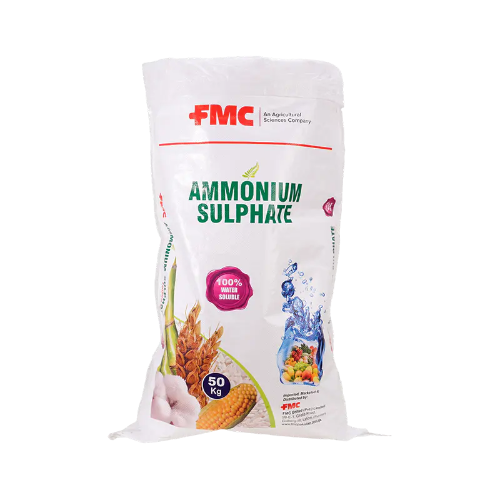
Once the bag becomes part of the customer's brand presentation — full-color logos, product photography, multi-language marketing copy — raw woven fabric can't hold up printing quality. Ink absorbs unevenly into the weave and colors bleed at the edges. This is where a BOPP Laminated Woven Bag substrate earns its cost: the laminate creates a smooth, non-porous surface for flexographic or rotogravure printing, so colors stay sharp instead of washing out within weeks of handling. It's standard practice among laminated PP woven bag manufacturers producing export-grade, retail-facing packaging. For clients wanting a slightly different aesthetic — a paper-like finish rather than a glossy film surface — a PP Laminated Kraft Paper Bag delivers the same print clarity with a kraft exterior that reads as more premium on shelf.
Quick Reference
| Shipping Condition / Client Need | Recommended Bag Type |
|---|---|
| Standard weight, inland or short-haul | PP Woven Bags |
| Heavy or palletized cartons | Reinforced high-gsm PP Woven Bags |
| Ocean freight, humid climates | Laminated Woven Bags / BOPP Laminated Woven Bag |
| Basic compliance labeling | Printed standard woven |
| Full-color branding, retail-facing | BOPP Laminated Woven Bag or PP Laminated Kraft Paper Bag |
The sizing formula gets you nearly all the way to the right bag. The remaining decision — fabric weight, lamination, print finish — comes down to knowing the shipping route and asking the client what they actually need the bag to do beyond just holding the carton together.
Get the Right Bag for Your Shipment
Matching carton dimensions to bag size and matching shipping conditions to fabric construction is exactly the kind of technical detail worth getting right before placing a bulk order. If you're sourcing PP Woven Bags, Laminated Woven Bags, BOPP Laminated Woven Bag, or PP Laminated Kraft Paper Bag for an upcoming shipment, send over your carton dimensions, transport route, and any printing requirements — a quick spec check upfront saves far more in returns and repacking costs than it takes to double-check now. Reach out for a sample or a sizing consultation before your next production run ships.




-
 +86-17757792457
+86-15868461338 -
 +8613957706306
-
 [email protected]
[email protected] -
 Guidé Village, Chuiyang, Aojiang Town, Pingyang County, Wenzhou City, Zhejiang Province, China
Copyright ©Zhejiang Hongyang Packaging Co., Ltd.



