


 Guidé Village, Chuiyang, Aojiang Town, Pingyang County, Wenzhou City, Zhejiang Province, China

 English
 Español
 عربى
 中文简体

How to Choose the Right PP Woven Bag Based on Intended Use: A Practical Buying Guide
Date:Nov 04, 2026
Selecting the appropriate PP woven bag involves more than just deciding on a 25kg, 40kg, or 50kg capacity. Different products have varying densities, packaging requirements, and storage conditions. A bag suitable for rice may not be appropriate for fertilizers, animal feed, or other industrial materials.
The right bag depends on the product being packaged, its weight, storage methods, and transportation conditions.
For buyers, understanding these distinctions helps avoid unnecessary packaging costs and reduces the risk of damage during handling and transit.
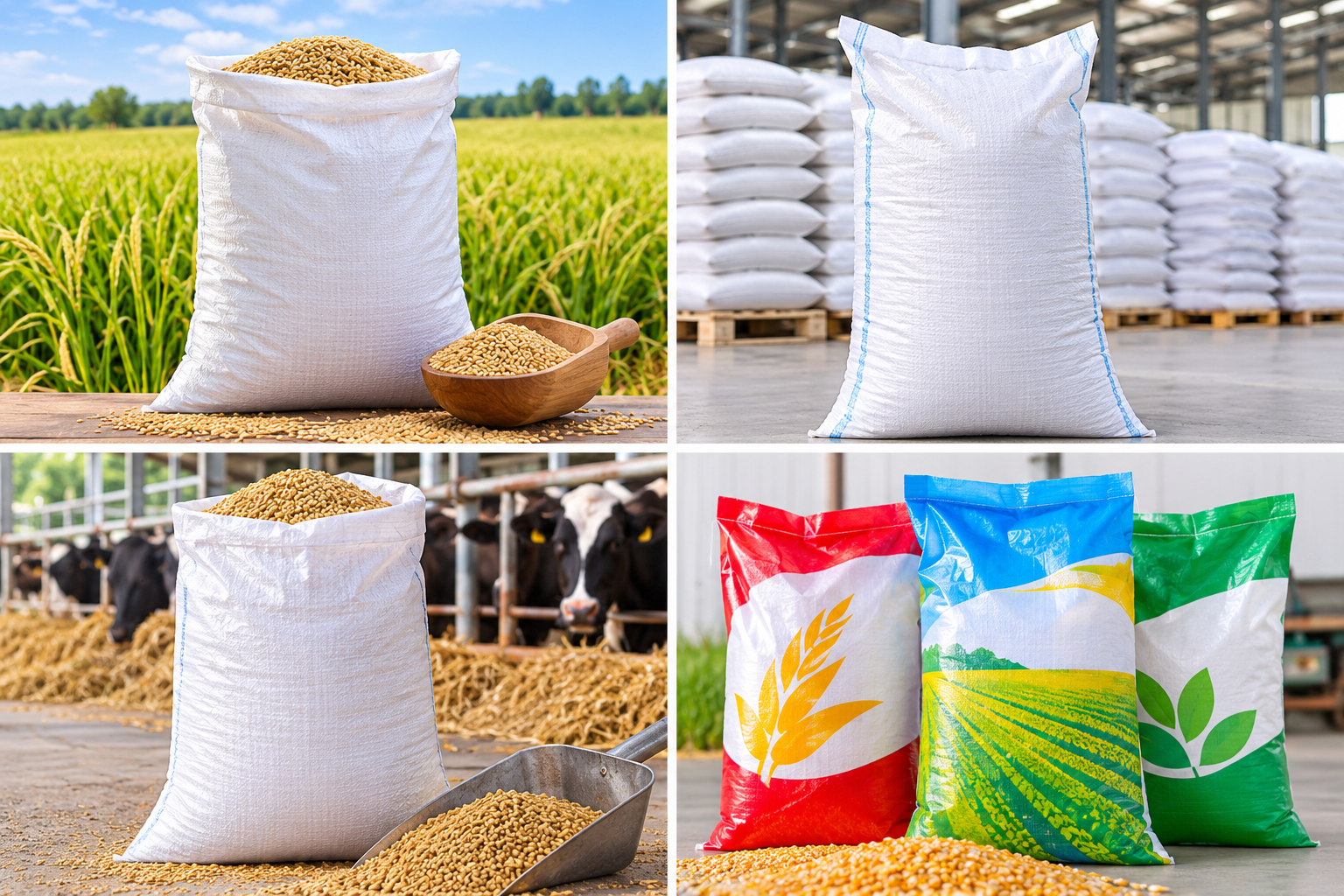
1. Rice Woven Bags: Choosing the Right Size and Strength
Rice is one of the most common applications for PP woven bags. Depending on market demands, rice packaging can range from small retail-sized bags to large commercial-grade sacks.
Common capacities include 5kg, 10kg, 25kg, and 50kg.
However, the actual dimensions of a bag depend on the rice variety, the packaging method, and the client’s specific requirements regarding appearance.
For instance, a 25kg bag intended for retail sale may require different dimensions (width and length) than a 25kg bag designed for bulk storage.
When selecting PP woven bags for rice, consider the following:
- Bag Dimensions: Determine the width and length based on the actual volume of the rice.
- Fabric Strength: The bag must be strong enough to withstand the pressure exerted during filling, stacking, and transportation.
- Printing Requirements: Options such as flexographic printing or BOPP lamination can be used to showcase branding and product information.
- Bag Construction: Details such as bottom stitching, hemmed edges, and other finishing touches affect the final product.
- Retail Needs: Smaller bags may require features like integrated handles or other designs that make them easy to carry. For rice products that require brand presentation, BOPP-laminated woven bags are generally a suitable choice—especially when there are high expectations regarding appearance and printed graphics.
For bulk rice packaging, standard (unlaminated) PP woven bags may be a more economical option.
The specific choice depends on the client’s target market, packaging requirements, and budget.
2. Fertilizer Woven Bags: Considering Product Characteristics and Moisture Protection
Packaging for fertilizers must be selected carefully based on the specific characteristics of the product.
Different fertilizers vary in terms of particle size, density, and sensitivity to moisture. These differences influence the required bag dimensions, the strength of the woven fabric, and the overall packaging structure.
Common specifications for fertilizer bags include 25 kg, 40 kg, and 50 kg capacities.
However, the load weight alone does not determine the full set of specifications for a bag.
For instance, two types of fertilizer might both require 50 kg packaging, but due to differences in product density, they may occupy different volumes—necessitating different bag dimensions.
When selecting fertilizer bags, consider the following:
- The density and volume of the fertilizer
- Whether the product is granular or powdered
- The required fabric weight (gsm) and strength
- Whether lamination is necessary
- Whether an inner liner is required
- Storage conditions and transportation methods
For products requiring extra protection against moisture, laminated bags or woven bags with inner liners should be considered.
It is important to note that not all fertilizers require the same bag structure.
Packaging should be selected based on the specific product and its unique protection requirements.
3. Animal Feed Woven Bags: Balancing Strength and Packaging Requirements
Animal feed represents another major application for PP woven bags.
Common products include feed for poultry, livestock, fish, and other agricultural applications.
Depending on the market and the specific product, common packaging sizes include 20 kg, 25 kg, and 50 kg.
Feed bags must be robust enough to withstand the stresses encountered during filling, handling, stacking, and transportation.
The appropriate bag structure depends on the type of feed.
For example, different feed products may vary in terms of particle size and density. This affects the volume of the bag required for a given weight of contents.
When selecting bags for animal feed, consider the following:
- Product density and bag dimensions
- Fabric weight (gsm) and strength
- Printing requirements
- Whether lamination is needed
- Storage and transportation conditions
- Bag opening and filling requirements
For companies selling branded feed, printed PP woven bags can be used for product identification and brand showcasing.
For high-volume feed packaging, the primary concerns may be bag strength, cost, and production efficiency.
The specific choice depends on how the bags will actually be used.
4. Packaging for Grains and Agricultural Products: Choosing the Right Bag for the Product
PP woven bags are widely used for packaging corn, wheat, beans, and other grains and agricultural products.
Different agricultural products vary in density and shape.
A 50 kg bag of corn may require different dimensions than a 50 kg bag of wheat or other grains.
This is why bags cannot be selected based on weight alone.
A bag that is too small will not accommodate the actual volume of the product, while one that is too large leads to unnecessary material costs.
When selecting bags for agricultural products, consider the following:
- The actual volume of the product
- The required fill weight
- Fabric strength
- Stacking methods
- Storage and transportation conditions
- Printing requirements
For agricultural products that require long-distance transport, the strength and construction of the bag should be carefully evaluated.
The goal is to select a bag that meets the requirements of actual usage conditions while avoiding unnecessary material costs.
5. BOPP Laminated Woven Bags: Ideal for Packaging Where Appearance Matters
BOPP laminated woven bags are typically used for products that require high-quality printing and an attractive appearance.
Applications include:
- Rice
- Animal feed
- Fertilizer
- Other agricultural products
BOPP laminated woven bags combine woven fabric with a printed film layer. This structure allows for full-color printing, detailed patterns, product information, and brand presentation.
Compared to standard printed woven bags, BOPP-laminated bags offer greater possibilities for customized packaging designs.
However, appearance should not be the only factor considered when selecting a bag.
Purchasers should also take into account:
- The product being packaged
- Required bag strength
- Print design
- Packaging dimensions
- Production quantity
- Budget
If a product does not require high-quality, full-color printing, a standard PP woven bag may be a more economical choice.
6. PP Woven Bags with Liners: A Choice for Added Protection
Some products require extra protection during storage and transport.
In such cases, using a bag with an internal liner is worth considering.
Depending on the material and construction, a liner can help protect the product from moisture, dust, or leakage.
However, not all packaging requires a liner.
Before opting for this structure, purchasers should consider:
- Whether the product is sensitive to moisture
- Whether the packaging requires additional sealing or leak-proof protection
- Storage environment
- Transportation conditions
- The level of protection required
For products with specific moisture-resistance requirements, the entire packaging structure must be evaluated, rather than relying solely on a liner.
The appropriate solution depends on the product itself and the actual packaging conditions.
7. How to Choose the Right Basis Weight and Strength for Woven Bags
GSM (grams per square meter) refers to the weight of the woven fabric per square meter.
While it is an important metric when selecting PP woven bags, it should not be the sole criterion for determining a bag's strength.
Two bags with the same basis weight may perform differently due to variations in:
- Quality of the PP yarn
- Yarn denier
- Weave density
- Fabric construction
- Lamination
- Stitching process
- Bag dimensions
A higher basis weight does not necessarily mean the finished bag will be stronger. For example, bags intended for short-distance transport may have different strength requirements compared to those used for export or multiple rounds of handling.
The required strength should be determined based on the product weight, filling method, stacking conditions, and the transport environment.
For buyers comparing offerings from different suppliers, it is advisable to evaluate the complete construction of the bag rather than focusing solely on the GSM (grams per square meter).
8. Why do woven bags with the same 50kg capacity have different prices?
Two different PP woven bags might both be capable of holding 50kg, yet their prices could vary significantly.
This is because their specific packaging requirements may differ.
One bag might use standard woven fabric, while another might require a higher basis weight (GSM), stronger yarn, lamination, or an inner liner.
Bag dimensions may also vary depending on the density of the product being packed.
Other factors that influence price include:
- Woven fabric basis weight (GSM)
- Bag dimensions
- Yarn specifications
- Number of printing colors
- Lamination
- Inner liners
- Bottom construction
- Order quantity
Therefore, comparing bags based solely on load capacity and unit price does not provide a complete picture.
A proper comparison should take into account the specific technical specifications and the intended use of each bag.
The goal is not merely to find the lowest price, but to select a bag that meets your packaging requirements while remaining cost-effective.
9. What information is needed when ordering PP woven bags?
If you are looking for custom PP woven bags, providing the right information will help the manufacturer recommend the appropriate specifications.
Before requesting a quote, it is recommended to have the following information ready:
1. Product Name
What product will the bag be used to pack?
(e.g., rice, fertilizer, animal feed, grain, or other products?)
2. Filling Weight
What is the weight (in kilograms) to be packed into each bag?
(e.g., 25kg, 40kg, or 50kg.)
3. Bag Dimensions
If you already have a technical drawing or a sample, please provide the width, length, and details of the bottom construction.
If you do not know the exact dimensions, the manufacturer can help determine the appropriate specifications based on your product.
4. Woven Fabric Requirements
If you already have specifications for the GSM (grams per square meter) or the bag itself, please provide them to the manufacturer for reference.
If you do not have specific requirements, the manufacturer can recommend a suitable starting point based on the intended use of the product.
5. Bag Construction
Do you require standard woven bags, laminated woven bags, BOPP-printed bags, bags with inner liners, or another type of construction?
6. Printing Requirements
Please provide your logo, design artwork, printing colors, and any product information that needs to be displayed.
7. Storage and Transport Conditions
Explain how the bags will be filled, stacked, stored, and transported.
This information helps determine the necessary strength and structural design of the bags.
8. Order Quantity
Provide the estimated purchase quantity and indicate whether you plan to make recurring, long-term orders.
This helps the manufacturer assess production scheduling and prepare price quotes.
10. Choose a PP Woven Bag Manufacturer That Understands Your Product’s Purpose
Hongyang Packaging produces a variety of PP woven bags and woven materials for diverse applications.
Our product range includes woven bags for rice, fertilizers, animal feed, and agricultural produce, as well as BOPP-laminated woven bags and custom-made woven materials.
We understand that different products require different packaging solutions.
A bag designed for rice may not be suitable for fertilizer or animal feed without adjustments to its dimensions and construction.
Therefore, we recommend basing your choice on the product itself, rather than selecting a bag solely based on the weight of the contents.
Whether you need standard woven bags, printed packaging, laminated bags, or custom woven materials, the bag specifications should align with your specific intended use.
We can assist you in evaluating the appropriate bag dimensions, fabric requirements, printing, and construction based on your unique packaging needs.
Looking for custom PP woven bags?
Please provide us with the product name, the weight of the contents, the required bag dimensions, and any specific packaging requirements. If you already have samples or technical drawings, you may also send them to us for evaluation. We will help you select the ideal packaging solution for your product.
Contact Hongyang Packaging to source custom PP woven bags directly from the factory. Website: https://wovenbagfactory.com




-
 +86-17757792457
+86-15868461338 -
 +8617757792457
-
 [email protected]
 -
 Guidé Village, Chuiyang, Aojiang Town, Pingyang County, Wenzhou City, Zhejiang Province, China
Copyright ©Zhejiang Hongyang Packaging Co., Ltd.


