


 Guidé Village, Chuiyang, Aojiang Town, Pingyang County, Wenzhou City, Zhejiang Province, China

 English
 Español
 عربى
 中文简体

Woven Shopping Bags vs. Non-Woven Bags: Which Is More Suitable for Retail Brands?
Date:Oct 16, 2026
A shopping bag doesn't seem like a big decision until something goes wrong. The handles tear on the way home, the bottom starts sagging under a few bottles, or the logo looks different from what the retailer approved. Suddenly, a small packaging purchase becomes a headache.
That's why the choice between woven shopping bags and non-woven bags deserves more attention than simply comparing prices. A supermarket carrying groceries has different needs from a clothing boutique handing customers a bag with every purchase. An exhibition organizer distributing thousands of promotional bags has a different budget again.
Both types can be customized, and both can work well in retail. The difference lies in how they're made, how they're constructed, and what you expect them to do. Getting those details right can save money and reduce complaints after delivery.
The Difference Is in How the Fabric Is Made
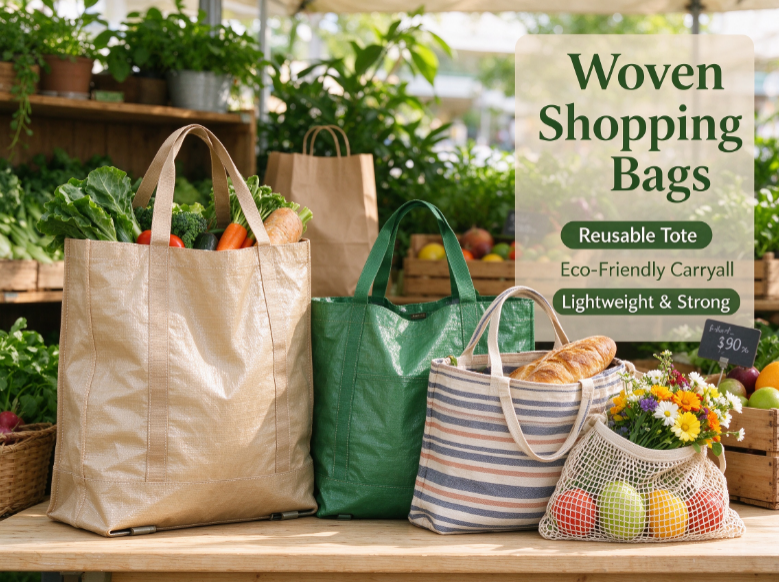
Woven shopping bags are made by interlacing strands of material to form a fabric. Polypropylene (PP) is commonly used, giving the bags a recognizable grid-like texture. These bags are often seen in supermarkets and grocery stores, where customers may use them repeatedly for everyday shopping.
Non-woven bags are made by bonding fibers together instead of weaving strands into a conventional fabric. Many are also made from polypropylene, but the surface usually looks smoother and feels more like fabric. This makes non-woven material popular for printed shopping bags, promotional giveaways, exhibitions, and general retail packaging.
The difference is easy to spot when you put the two side by side. Woven bags tend to have a more obvious texture, while non-woven bags usually have a softer, more uniform surface.
But don't judge a bag by its material alone. A lightweight woven bag with poorly attached handles can fail under load. A non-woven bag made from a suitable fabric, with reinforced handles and properly finished seams, may hold up well through repeated use.
What goes inside the bag matters just as much as what it's made from. Carrying a T-shirt and a few small purchases is one thing. Carrying glass bottles, cans, or heavy groceries is another.
Will the Bag Hold Up to Everyday Shopping?
Imagine a customer filling a shopping bag with groceries, lifting it into a car, then using it again the following week. That's a different job from carrying a few brochures around an exhibition hall.
Woven bags are commonly chosen for regular shopping because their construction can provide a firm, sturdy body. They're a practical option for many grocery applications, provided the material, seams, and handles match the expected load.
Non-woven bags aren't all lightweight promotional products, either. They come in different fabric weights and can be made with reinforced handles, stronger seams, and a more substantial base. A lightweight version may suit a short campaign, while a heavier one may work for repeated shopping trips.
So which type lasts longer? There's no automatic winner. A poorly assembled woven bag may fail sooner than a properly constructed non-woven version. The finished design makes a real difference.
When samples arrive, don't just turn them over in your hands and decide they look sturdy enough. Check a few practical details:
- Fabric weight: Compare the actual specifications. Heavier material can help, but it doesn't guarantee that the whole bag is stronger.
- Handles: Look at the attachment points and stitching. These areas take a lot of strain when a bag is lifted.
- Bottom and side seams: Check for weak corners, loose threads, or poorly finished edges.
- Size: Make sure the bag can hold the products customers normally buy from your store.
- Repeated use: If the bag is intended to be reusable, test it after carrying, folding, and storing it several times.
For bags that need to carry bottles or canned goods, tell the manufacturer what customers are likely to put inside. Agree on appropriate load requirements and testing before production. A bag that looks fine when empty may behave quite differently when full.
How Will the Bag Look With Your Logo on It?
For some retailers, appearance is just as important as carrying capacity. A shopping bag may leave the store with the customer and turn up again on a shopping trip, at work, or on public transport. The logo can stay visible long after the original purchase.
Woven bags have a noticeable texture that suits practical, reusable shopping designs. Some retailers like their structured appearance, particularly for grocery bags and everyday carrying. The textured surface can, however, affect how fine printed details appear.
Non-woven bags offer a softer look and a relatively uniform printing surface. They work well for simple logos, larger graphics, promotional messages, and designs that use several colors. The choice of fabric colors, handle styles, and bag shapes also gives brands room to experiment.
Printing still needs to be checked against the actual material. Some woven bags use lamination to provide a smoother surface, while non-woven fabrics have their own limits when it comes to fine details and color matching.
A digital design can look great on a screen and still produce a disappointing result on fabric. That's why it pays to request a physical sample with your own artwork.
Check the logo size, position, colors, and finish. For a brand with strict color requirements, agree on the printing specifications before approving the production run. It's much easier to correct an issue on a sample than to deal with thousands of finished bags.
What Actually Changes the Price?
Two quotations can look quite different even when both suppliers are offering non-woven bags, or both are quoting woven ones. The reason is often hidden in the specifications.
A simple non-woven bag for a promotional event may cost less than a heavily constructed reusable bag with reinforced handles and custom printing. Woven bags can also become more expensive when the design includes heavier fabric, lamination, special printing, or additional reinforcement.
Common customization options include:
- Size and gusset depth: These affect how much the bag holds and how it sits when filled.
- Fabric color: The material can be selected to match a store's branding.
- Printing: Artwork, logo placement, and color requirements affect production.
- Handle design: Length, material, color, and attachment method can all vary.
- Reinforcement and lamination: These may be needed for particular carrying or printing requirements.
- Packaging and labeling: Important for distributors and private-label orders.
When requesting quotations, send the same specifications to each manufacturer. Otherwise, you might compare a lightweight bag from one factory with a heavier, reinforced version from another. The difference in price won't tell you much.
|
Purchasing factor |
Woven shopping bags |
Non-woven bags |
|---|---|---|
|
Fabric construction |
Interlaced strands |
Bonded fibers |
|
Feel and appearance |
Textured, often more structured |
Softer, fabric-like surface |
|
Common uses |
Grocery shopping and reusable retail bags |
Promotions, exhibitions, and general retail packaging |
|
Printing |
Depends on texture and surface finish |
Depends on fabric and printing method |
|
Main cost factors |
Material, construction, coating, printing, quantity |
Fabric weight, size, printing, reinforcement, quantity |
|
Durability |
Depends on material and construction |
Depends on fabric weight and construction |
Don't forget the other costs, either. Sample charges, printing setup, packaging, shipping, and any special labeling can all affect the final amount you pay. A low unit price doesn't necessarily mean a lower total order cost.




-
 +86-17757792457
+86-15868461338 -
 +8617757792457
-
 [email protected]
 -
 Guidé Village, Chuiyang, Aojiang Town, Pingyang County, Wenzhou City, Zhejiang Province, China
Copyright ©Zhejiang Hongyang Packaging Co., Ltd.


