


 Guidé Village, Chuiyang, Aojiang Town, Pingyang County, Wenzhou City, Zhejiang Province, China

 English
 Español
 عربى
 中文简体

How Woven Polypropylene Bags Serve Agricultural Co-Products and By-Products
Date:Nov 13, 2026
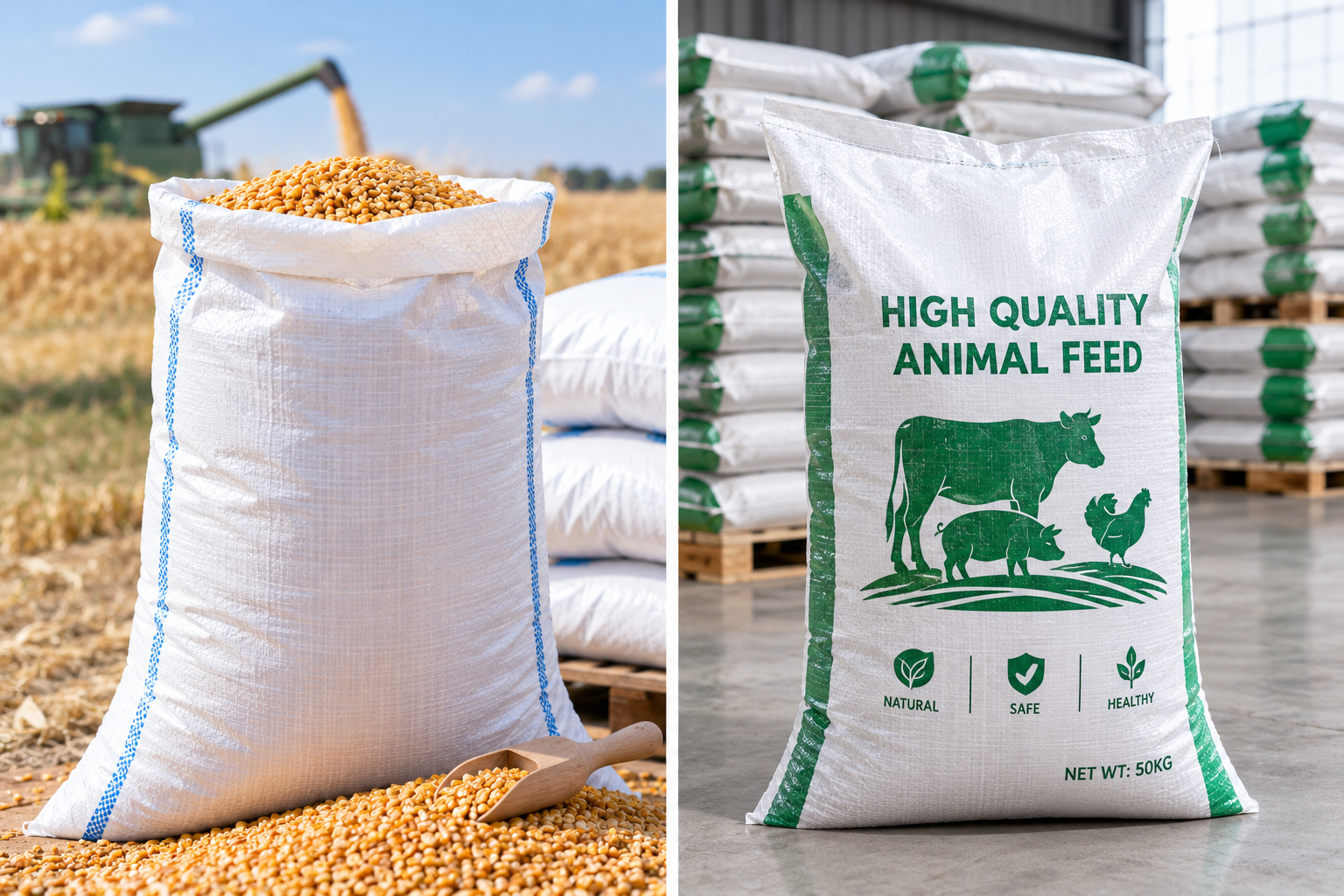
Grain mills, oilseed processors and feed blenders generate secondary streams alongside their primary products. Bran, hulls, screenings, meal fractions and other dry residues still require orderly collection, storage and transport. These materials differ in particle size, bulk density and flow behaviour, so the packaging must accommodate that variety without excessive spillage or bag failure. Woven Polypropylene Feed Bags provide one established format for such dry agricultural streams when the fabric strength, bag dimensions and closure method are matched to the specific material. Polypropylene Feed Bags of woven construction are therefore evaluated against particle characteristics, fill weight and handling conditions rather than assumed to suit every by-product without qualification.
Nature of Agricultural Co-Products and Processing Residues
Streams Arising from Grain Milling and Cleaning
When cereal grains are cleaned and milled, fractions such as bran, shorts, dust and broken kernels separate from the main flour or grits stream. These secondary materials retain value as feed ingredients or as further-processed products, yet they must be contained promptly to keep the plant clean and to prevent loss. Particle size can range from fine powder to coarse flakes, and the same packaging line may encounter several of these fractions in a single shift.
Residues Incorporated into Animal-Feed Formulations
Many by-products become ingredients in compound feed. Oilseed meals, distiller's grains, hulls and similar dry materials are weighed, blended and bagged for delivery to farms or feed mills. The packaging must hold the intended net weight securely through stacking, forklift handling and road or rail transport while remaining identifiable by type and batch.
Other Dry Agricultural Materials That Require Bagging
Beyond mill by-products, operations may bag dried plant residues, seed cleanings or other low-moisture agricultural solids that are sold or transferred in discrete units. The common requirement is a container that resists tearing under ordinary handling and that can be filled and closed at a rate compatible with the plant's output.
Packaging Demands Across Varied Agricultural Materials
Accommodation of Fine, Coarse and Irregular Particles
Fine powders tend to sift through loose weaves or poorly sealed seams; coarse or irregular pieces can abrade fabric or stress individual tapes. The weave density, any coating on the fabric and the integrity of the stitched or sealed closures are therefore chosen with the particle-size distribution in mind. A bag that performs well with coarse bran may allow unacceptable dust escape when filled with a finer meal.
Relationship Between Fill Weight and Bag Dimensions
Bulk density varies widely among co-products. A bag sized for a dense meal will be only partly full when used for a lighter hull fraction, while the reverse situation risks overfilling and seam strain. Capacity is selected so that the target fill weight sits comfortably within the bag's safe working range, leaving enough headspace for closure without forcing material into the seams.
Control of Spillage During Handling and Distribution
Spillage wastes product, creates housekeeping problems and can contaminate other lots. Secure closures, adequate seam strength and, where needed, an inner liner reduce the routes by which fine material escapes. Handling practices—hook use, conveyor drops and stacking height—also influence whether the bag remains intact from filler to end user.
Alignment With Storage and Transport Conditions
Bags may be stored in open sheds, closed warehouses or outdoors for limited periods, and they may travel by truck, rail or container. Exposure to moisture, ultraviolet light and repeated mechanical stress affects both the fabric and any printed identification. The packaging specification takes account of the expected storage duration and the transport mode so that the bags arrive in usable condition.
Reasons Woven Polypropylene Is Frequently Specified
Construction That Withstands Routine Handling
The interlaced tapes of a woven polypropylene fabric distribute tensile loads and resist puncture better than many lightweight film alternatives when the contents are abrasive or when bags are dragged or stacked. Seam design and fabric weight are still critical; the woven structure alone does not guarantee performance if the bag is under-specified for the load.
Format Flexibility for Different Filling Lines
Open-mouth bags, valve bags and other common styles can be produced from the same basic woven fabric. The choice of style follows the filling equipment already installed and the preferred method of closing—sewing, heat sealing or ultrasonic sealing where applicable. This flexibility allows a single material family to serve several packaging points within a plant.
Surface Area for Identification of Material and Batch
Even when elaborate multi-colour graphics are unnecessary, simple print or attached labels identifying the material type, batch code and net weight help prevent mix-ups in storage and at loading. The woven surface accepts print or labels sufficiently for this functional identification, provided the ink or adhesive is suited to the fabric and to the storage environment.
Application of Woven Bags to Feed Ingredients and Dry By-Products
Suitable Uses With Feed Ingredients, Seeds and Dry Residues
Woven polypropylene bags are commonly used for dry feed ingredients, certain seed lots and dry processing by-products whose particle size and moisture content fall within the range the bag construction can contain. Suitability is confirmed for each material rather than extended by assumption to wet, oily or extremely fine powders that may require liners or alternative packaging.
Matching Bag Specification to Material Behaviour
Fabric weight, weave tightness, coating, dimensions and closure type are selected according to the bulk density, particle size and abrasiveness of the product. A specification that works for one co-product is not automatically transferred to another without checking these characteristics against the bag's rated capacity and seam performance.
Confirmation of Load and Closure Method
The intended fill weight is compared with the bag's design limits, and the closure method is verified to hold that weight under the expected stacking and handling regime. Open-mouth bags that will be sewn, or valve bags that rely on the internal pressure of the product, each impose different requirements on the top construction.
Discussion of Application-Specific Requirements
Processors who describe the material's particle size, moisture range, target fill weight and handling sequence enable the bag supplier to propose a construction that addresses those conditions. Early exchange of this information reduces the risk of receiving bags that sift, burst or fail to close properly on the existing filling line.
Points to Verify Before Adopting Woven Bags for By-Products
Density, Particle Size and Filling Method
Bulk density determines how full the bag will appear at the target weight. Particle size indicates whether a tight weave or a liner is needed to control dust. The filling method—gravity spout, screw or pneumatic—affects how the product impacts the bag and how much air must escape during filling.
Moisture Level and the Possible Need for a Liner
Although many co-products are dried before bagging, residual moisture or hygroscopic behaviour can still soften fabric or encourage mould during storage. Where moisture protection is required, an inner liner or a coated fabric is considered and tested with the actual product.
Storage, Transport and Any Applicable Packaging Rules
The expected storage environment, transport mode and any customer or regulatory requirements for packaging agricultural materials are listed so that the bag specification addresses them. Documentation of fabric type, food- or feed-contact status where relevant, and closure method may be requested by downstream buyers.
Overview of Material Characteristics and Packaging Responses
| Material Characteristic | Packaging Implication | Confirmation Step |
|---|---|---|
| Fine particle size | Risk of sifting through weave or seams | Assess weave density; consider coating or liner |
| Coarse or abrasive particles | Increased wear on fabric and seams | Select adequate fabric weight and seam construction |
| Variable bulk density | Fill volume changes at constant weight | Size bag to actual density and target weight |
| Residual moisture | Possible fabric softening or product quality loss | Evaluate need for liner or coated fabric |
| Stacking and handling stress | Seam and fabric tensile demand | Match bag construction to stack height and handling |
| Need for identification | Print or label durability in storage | Confirm print method or label adhesion on fabric |
Matching Woven Bag Construction to Diverse Agricultural Streams
Dry agricultural co-products and by-products can be packed in woven polypropylene bags when particle size, moisture content, fill weight and handling conditions are known and the bag specification is chosen accordingly. The woven structure supplies the tensile strength needed for routine stacking and transport, while format and closure options adapt to different filling lines. Zhejiang Hongyang Packaging Co., Ltd. produces woven polypropylene bags for agricultural packaging applications including feed ingredients, seeds, grain and suitable dry by-products. Review of fabric constructions, dimensions, closure styles and any liner options against the specific material properties and logistics requirements allows selection of bags that contain the product securely through storage and distribution.




-
 +86-17757792457
+86-15868461338 -
 +8617757792457
-
 [email protected]
 -
 Guidé Village, Chuiyang, Aojiang Town, Pingyang County, Wenzhou City, Zhejiang Province, China
Copyright ©Zhejiang Hongyang Packaging Co., Ltd.



