


 Guidé Village, Chuiyang, Aojiang Town, Pingyang County, Wenzhou City, Zhejiang Province, China

 English
 Español
 عربى
 中文简体

How Polypropylene Feed Bags Fit into Automated Bagging Lines
Date:Nov 20, 2026
Automated bagging lines move empty bags through feeding, filling, closing and downstream handling with minimal manual intervention. Each station expects the bag to present a predictable opening, consistent dimensions and a structure that the machine can grip, fill and seal without repeated adjustment. When bag specifications drift from those expectations, the line stops for clearing, re-threading or cleaning of spilled product. Woven Polypropylene Feed Bags that are dimensioned and constructed for the actual equipment therefore support continuous operation more effectively than bags chosen solely by capacity or price. Polypropylene Feed Bags of woven construction are evaluated against the same mechanical and dimensional criteria before they are introduced into a running line.
How Are Woven Polypropylene Feed Bags Used in Automated Bagging Lines
Automated bagging lines move empty bags through feeding, filling, closing and downstream handling with minimal manual intervention. Each station expects the bag to present a predictable opening, consistent dimensions and a structure that the machine can grip, fill and seal without repeated adjustment. When bag specifications drift from those expectations, the line stops for clearing, re-threading or cleaning of spilled product. Woven Polypropylene Feed Bags that are dimensioned and constructed for the actual equipment therefore support continuous operation more effectively than bags chosen solely by capacity or price. Polypropylene Feed Bags of woven construction are evaluated against the same mechanical and dimensional criteria before they are introduced into a running line.
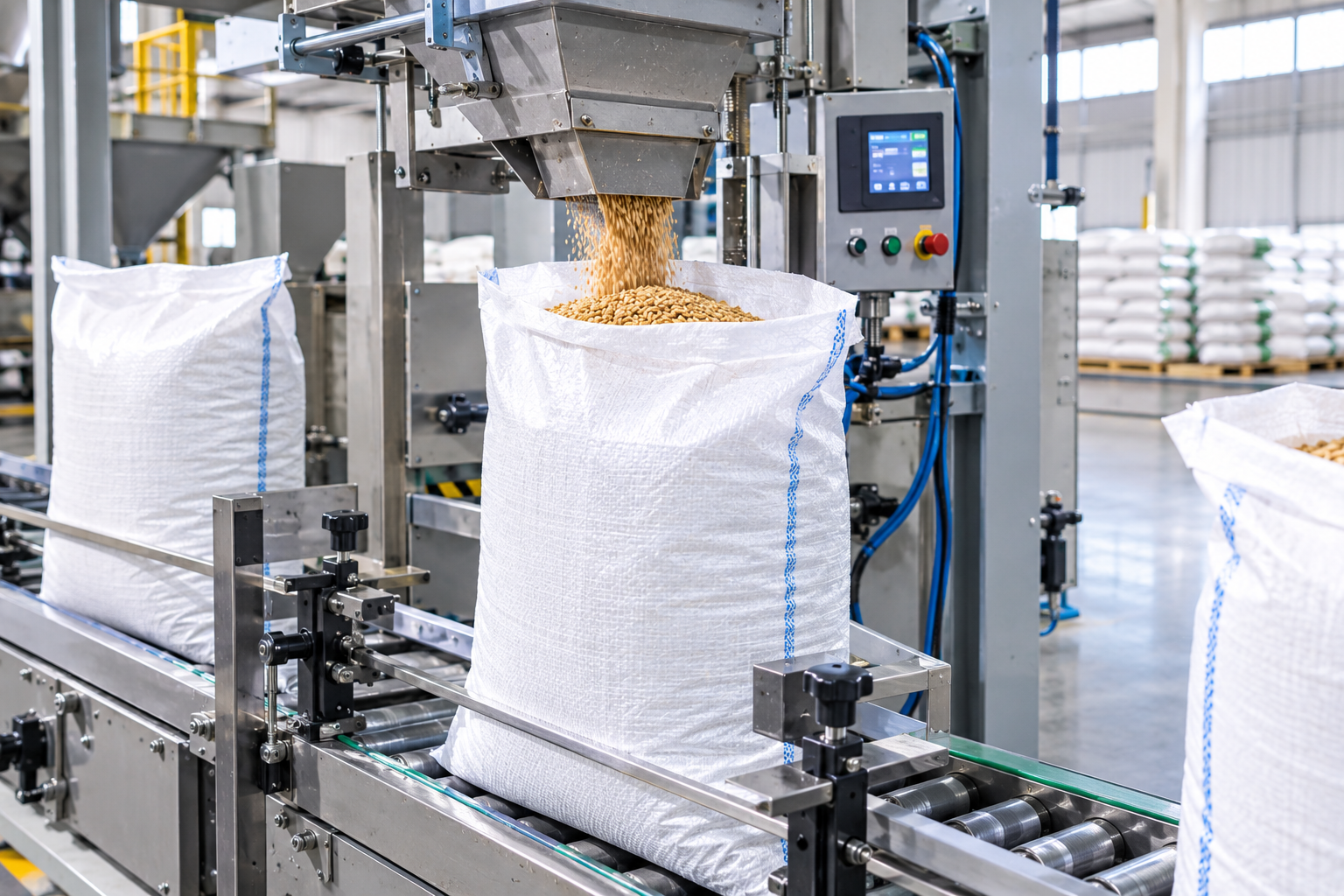
Sequence of Operations on a Typical Automated Bagging Line
Presentation and Positioning of Empty Bags
Empty bags enter the filling station either from a magazine, a wicket or a manual placement point. The equipment spreads or holds the mouth so that the filling spout can enter cleanly. Variation in overall length, width or mouth opening causes the bag to sit off-centre or to present an incomplete aperture. Consistent flat dimensions and a mouth that opens uniformly reduce the need for the operator to intervene at this stage. Manual placement allows more tolerance for minor variation; automatic feeders demand tighter control of size and of the way bags are stacked or nested before they reach the machine.
Filling With Feed, Seed or Grain
Weighing systems dispense a target mass of product into the open bag. Particle size, flowability and the chosen fill weight influence how the material settles and how much air must escape during filling. The bag mouth must remain aligned with the spout throughout the discharge so that product does not cascade over the outside of the fabric. A mismatch between spout geometry and bag opening, or a bag that shifts under the weight of the falling product, produces spillage and forces a stop for cleaning.
Transfer, Closing and Subsequent Handling
Once filled, the bag is released onto a conveyor or is transferred by a mechanical arm to the closing station. Sewing, heat sealing or another closure method then secures the mouth. The amount of free fabric left above the product, the straightness of the top edge and the stability of the filled shape all affect how cleanly the closer can operate. After closing, the bag may pass a check-weigher, a label applicator or a palletising robot. An irregular or leaning profile at this stage complicates automated stacking and can reduce the number of bags that fit safely on a pallet.
Bag Characteristics That Influence Machine Performance
Overall Dimensions and Mouth Opening
Length, width and the size of the opening must fall inside the range the feeder and the filling spout can accept. A mouth that is too narrow will not accept the spout without force; a bag that is excessively long may drag on guides or fold before it is filled. Purchasing decisions based only on nominal capacity overlook these machine-specific limits. Supplying the equipment's stated empty-bag dimensions, including tolerances, allows the bag maker to deliver a size that the line can run without constant correction.
Fabric Structure, Flexibility and Dimensional Consistency
Woven polypropylene tapes give the bag tensile strength while still allowing the fabric to flex when the machine opens the mouth or settles the product. Excessive stiffness can resist spreading; excessive softness can cause the bag to collapse or wrinkle in the feeder. Consistency of cut size and of seam placement from bag to bag keeps the machine's sensors and mechanical stops in the same relationship to the fabric on every cycle. Buyers therefore confirm not only the nominal fabric construction but also the dimensional tolerances that will be held in production.
Mouth Configuration and Compatibility With the Closer
The way the top of the bag is formed—plain open mouth, hemmed edge or another style—determines how the closer grips and seals the fabric. A sewing head expects a certain free length of material above the product; a different closure system may require a cleaner or more uniform edge. The bag specification is written to match the closure method already installed on the line rather than assuming that any open-mouth woven bag will suit every closer.
Filled Weight, Resulting Shape and Handling Stability
The target fill weight, together with the bulk density of the product, decides how full the bag becomes and whether the filled shape remains stable on a conveyor. An under-filled bag may slump or fold; an over-filled bag may strain seams or present a rounded profile that rolls on the belt. Trials with the actual product and the intended weight reveal whether the chosen bag dimensions produce a shape that transfers and stacks reliably.
Frequent Bag-Related Disruptions on Automated Lines
Inconsistent Opening at the Feeding Station
When mouths do not open to a uniform shape or when bags arrive at slightly different positions, the feeder may miss the grip or the spout may strike the fabric. Causes include variation in bag dimensions, differences in how bags were packed in the carton, or settings on the feeding mechanism itself. Distinguishing between bag variation and machine adjustment prevents unnecessary changes to a bag specification that is otherwise within tolerance.
Interruptions and Spillage During Filling
Spillage occurs when the mouth is not fully seated on the spout, when the bag shifts as product lands, or when the discharge rate exceeds the bag's ability to vent air. Checking mouth dimensions against the spout, verifying alignment sensors and confirming that the fill weight matches the bag volume are the usual steps before any change to the bag order is considered.
Problems at the Closing Station
If the top of the bag is not presented flat or if insufficient free fabric remains above the product, the sewing head or sealer may produce skewed, incomplete or weak closures. Residual product on the sealing surface can also interfere. Ensuring that the bag provides the free length required by the closer, and that the filled height is consistent, reduces these faults.
Irregular Shapes During Conveying and Palletising
Bags that lean, bulge unevenly or vary in overall height complicate photo-eye detection and robotic or conventional palletising. The combination of bag dimensions, fill weight and product distribution inside the bag determines the final silhouette. Evaluating filled bags on the actual conveyor and palletiser, rather than judging only empty samples, identifies shape-related issues before a large order is placed.
Steps for Evaluating Bags Before Full-Scale Integration
Documentation of the Existing Equipment Requirements
The bag-feeding method, filling spout size, closure type and any stated limits on bag length, width and opening are recorded. Product types, target fill weights and the intended downstream path (check-weighing, labelling, palletising) are added so that the bag specification addresses the whole sequence.
Comparison of Samples With the Written Specification
Empty bags are measured and examined for mouth formation, seam placement and overall consistency. The measurements are compared with the dimensions required by the equipment. Samples that match the specification become the reference for bulk production; samples that deviate are corrected before any volume order is released.
Trial Runs With Actual Product and Operating Settings
A limited number of bags are run through the full sequence—feeding, filling to the target weight, closing and transfer—under normal line conditions. Any misfeeds, spills, closure defects or handling difficulties are noted. Results determine whether the bag specification, the machine settings or both require adjustment.
Inspection Criteria for Ongoing Deliveries
Once a bag specification is proven on the line, incoming shipments are checked against the same dimensional and construction criteria. Consistent application of those checks reduces the chance that a later batch will introduce variation that forces the line to be re-tuned.
Overview of Bag Attributes and Line Interactions
| Bag Attribute | Interaction With the Automated Line | Verification Method |
|---|---|---|
| Length, width, mouth opening | Feeding accuracy and spout engagement | Measure against equipment limits; trial feed |
| Fabric flexibility and consistency | Reliable gripping and mouth spreading | Compare samples; observe feeder behaviour |
| Mouth style and free top length | Clean presentation to the closer | Match to closure type; inspect closed bags |
| Capacity relative to fill weight | Stable filled shape for conveying and stacking | Trial fill with actual product and weight |
| Dimensional tolerance in production | Repeatability across shifts and batches | Incoming inspection against agreed tolerances |
| Compatibility with handling equipment | Smooth transfer and palletising | Run filled bags through downstream stations |
Aligning Bag Construction With the Demands of Automated Packaging
Automated bagging lines depend on empty bags that open consistently, accept the intended fill weight without spillage and present a uniform top edge to the closer. Dimensional accuracy, fabric behaviour and mouth design are therefore specified in relation to the actual feeder, spout and closure equipment rather than in isolation. Zhejiang Hongyang Packaging Co., Ltd. produces woven polypropylene bags for feed, seed and grain packaging applications. Review of bag dimensions, mouth configuration, fabric construction and closure compatibility against the documented requirements of the filling line supports selection of bags that run with minimal interruption through automated feeding, filling and closing sequences.




-
 +86-17757792457
+86-15868461338 -
 +8617757792457
-
 [email protected]
 -
 Guidé Village, Chuiyang, Aojiang Town, Pingyang County, Wenzhou City, Zhejiang Province, China
Copyright ©Zhejiang Hongyang Packaging Co., Ltd.



