


 Guidé Village, Chuiyang, Aojiang Town, Pingyang County, Wenzhou City, Zhejiang Province, China

 English
 Español
 عربى
عربى 中文简体
中文简体
How to Choose PP Woven Bags for Feed Packaging
Date:Jun 05, 2026
Grain arrives at the warehouse and the bags are already showing moisture damage. Feed pallets come off the truck with torn seams. Rice packaging looks washed out on the shelf, and reorder conversations quickly turn into complaints. These are not hypothetical scenarios — they happen when the packaging specification does not match what the product actually needs. A PP Woven Bag handles bulk agricultural loads reliably, but the right configuration depends on the product going inside, the conditions it faces, and what the bag needs to do beyond simply holding weight. Grain, rice, and animal feed share a category but not a packaging requirement. Grain needs to breathe. Rice typically needs moisture protection and a printable surface. Feed demands puncture resistance and contamination prevention. Getting those distinctions right before placing an order is the difference between packaging that works and packaging that causes problems downstream.
What Is a PP Woven Bag?
A PP Woven Bag is made by extruding polypropylene resin into flat strips, then weaving those strips into a fabric. The woven structure is both the source of its strength and the reason it behaves differently from a plain film bag. Force applied at any point distributes across the interlocked weave rather than concentrating at one spot — which is why these bags hold up under heavy loads and rough handling in ways that simpler materials do not.
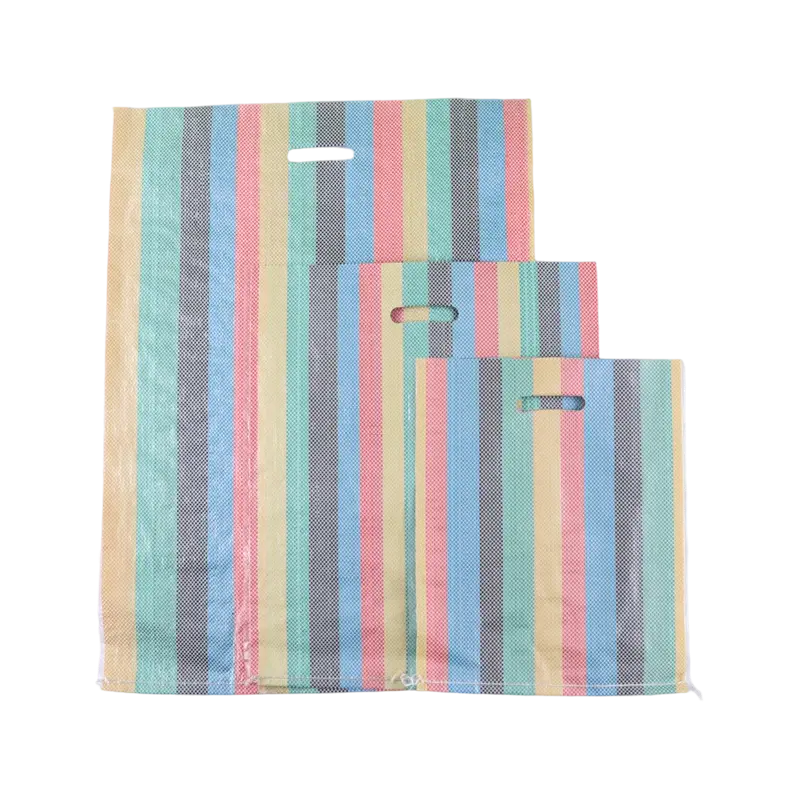
The term PP Fabric Bag refers to the same construction. Whether a supplier lists it as a woven polypropylene bag or a PP Fabric Bag, the underlying material and structure are the same. The variation comes from what gets added to that base: lamination, inner liners, valve closures, surface printing.
Key properties of the base format:
- Lightweight relative to the structural load it supports
- Tear and puncture resistant under standard agricultural handling
- Cost-effective for bulk orders at scale
- Reusable in many farm and industrial storage contexts
- Breathable in the unlaminated form, which matters for certain products
That last point — breathability — is where grain, rice, and feed packaging start to diverge. It is not a minor technical detail. For living or respiring commodities, it directly affects shelf life and product quality.
Why PP Woven Bags Are Widely Used for Grain, Rice, and Feed Packaging
The agricultural sector handles enormous volumes of bulk dry goods under variable storage and transit conditions. Packaging in this context needs to carry weight without tearing, resist the moisture and temperature swings that come with warehouse environments, and hold up through the stacking, loading, and unloading cycles that happen repeatedly across a supply chain.
Woven Polypropylene PP Bags meet these demands in ways that paper bags, plain film bags, or non-woven alternatives generally do not. Paper weakens with moisture exposure and tears under sustained mechanical stress. Plain film lacks the load distribution that a woven structure provides. Non-woven polypropylene is designed for lighter consumer applications, not bulk industrial loads.
What makes the woven format so persistent in agricultural packaging is not one standout property — it is the combination. Strength, cost, customizability, and the ability to add protective layers when the application needs them. That flexibility is what allows the same base material to serve grain, rice, and feed packaging with different configurations.
Standard PP Woven Bag vs Laminated PP Woven Bag: Which Suits Agricultural Products?
This is the decision that shapes many agricultural packaging specifications. The base woven bag and the laminated version are built from the same polypropylene fabric, but they serve different purposes.
| Feature | Standard PP Woven Bag | Laminated PP Woven Bag |
|---|---|---|
| Moisture Resistance | Moderate | High |
| Breathability | High | Low |
| Printing Quality | Limited colors | Multi-color, sharp detail |
| Surface Appearance | Textured, plain | Smooth, finished |
| Cost | Lower | Higher |
| Suitable For | Grain, seeds, breathable crops | Rice, feed, branded food products |
| With Inner Liner Option | Yes | Yes |
| Recyclability | Straightforward | More complex |
Standard woven bags allow air to move through the fabric. That breathability is a functional requirement for certain agricultural products, not a compromise. Sealing grain or seeds in a non-breathable container creates condensation, which causes spoilage.
Laminated bags bond a film layer to the outer surface, which seals that airflow. The result is strong moisture resistance and a smooth surface that holds detailed printed graphics. For rice brands, feed manufacturers who need contamination protection, or any product that would deteriorate if moisture reached it, lamination addresses a real performance need.
The choice is not about one format being better than the other. It is about which properties match the product.
PP Woven Bags for Grain Packaging
Grain storage and transport impose specific demands that do not necessarily call for lamination. In fact, laminating a grain bag can cause more problems than it solves.
Cereal grains respire during storage. They produce internal moisture, and if that moisture cannot escape through the bag wall, it condenses inside the bag and accelerates spoilage and mold growth. A breathable woven polypropylene PP bag allows that internal humidity to dissipate, which keeps the grain in stable condition through extended warehouse storage.
What grain packaging does need:
- High tensile strength to handle bulk fill weight without seam failure
- Breathable woven construction that prevents condensation buildup
- Consistent seam quality for stacking under warehouse conditions
- UV-stabilized fabric for outdoor or partially exposed storage where applicable
- Reliable fill capacity across bag dimensions
For bulk grain destined for processing or export, the plain woven format is the practical choice. The functional argument for lamination simply does not apply here. A standard PP Fabric Bag built to the right GSM and seam specification handles grain reliably at a cost point that makes sense for high-volume agricultural purchasing.
If additional moisture protection is needed — for a particularly sensitive grain variety or a high-humidity shipping route — the practical solution is a PE inner liner inserted into a plain woven outer shell. That preserves the external breathability option while adding an internal barrier.
PP Woven Bags for Rice Packaging
Rice packaging pulls in the opposite direction from grain. Moisture protection matters. So does surface quality. And for rice brands with retail visibility, the bag is part of the product presentation, which means print quality and appearance are not secondary considerations.
Laminated PP Woven Bags are the standard configuration for rice. The film layer blocks ambient moisture from penetrating the fabric wall. The smooth outer surface accepts detailed, multi-color printing cleanly — logos, product photography, cooking instructions, and nutritional information all read clearly on laminated surfaces in ways that raw woven fabric simply cannot support.
BOPP laminated woven bags are particularly common in this application. The biaxially oriented film used in BOPP lamination produces a surface with strong ink adhesion and consistent color reproduction, which suits brands that need the packaging to reflect product quality at retail.
A Kraft Paper Laminated PP Woven Bag serves a related but distinct segment of the rice market. The paper outer surface communicates naturalness and premium positioning — qualities that certain rice brands actively cultivate. Underneath that paper exterior, the woven polypropylene structure carries the load and prevents the bag from failing under the actual weight of the product. For producers targeting health-oriented or premium retail channels, this format offers visual differentiation alongside structural reliability.
Inner liners are also common in rice packaging. A PE film liner inside a laminated outer bag provides a secondary moisture barrier and keeps the rice free from any contact with the bag material itself — relevant for food safety compliance in certain export markets.
PP Woven Bags for Animal Feed Packaging
Feed packaging deals with different stresses than grain or rice. Animal feed is often dense, irregularly textured, and heavy per bag. It moves through rough handling environments — farm deliveries, loading docks, outdoor storage — and the packaging needs to survive all of it without tearing or contaminating the contents.
Laminated woven bags are the standard here, and for practical reasons. Feed is sensitive to moisture — both because moisture encourages mold and because wet feed degrades quickly. The laminated wall keeps ambient moisture out. At the same time, feed packaging typically needs to carry printed product information, feeding instructions, and brand graphics that can withstand outdoor conditions.
What feed packaging specifically needs:
- Seam strength built for dense, heavy fill weights
- Laminated outer surface for moisture protection
- PE inner liner for contamination-sensitive formulations
- Consistent bag dimensions for palletizing and warehouse stacking
- Printing that remains legible after outdoor exposure
Seam quality deserves particular attention in this application. A bag that looks correct from the outside can still fail at the seam under the mechanical stress of a full heavy load dropped during delivery. Specifying seam construction and requesting load test samples — not just visual samples — is the practical way to verify this before committing to a production run.
Why Kraft Paper Laminated PP Woven Bag Works in Agricultural Packaging
The kraft paper laminated format is worth understanding separately because it sits in a distinct position in the market. It is not simply a more expensive version of a plain laminated bag — it is a different visual and functional proposition.
The paper outer surface communicates something that plastic film does not. For agricultural products positioned at the premium or natural end of the market — specialty rice varieties, organic seed, heritage grain products — the tactile quality of the paper surface signals product identity before the buyer reads a single word on the label. That perception matters in retail environments and specialty food channels.
Functionally, the Kraft Paper Laminated PP Woven Bag delivers:
- Visual warmth and texture that film-laminated surfaces cannot replicate
- Strong structural integrity from the woven polypropylene layer underneath
- A printable surface that handles detailed, brand-quality graphics
- Protection against moisture and contamination through the laminated construction
- A format that works across both retail shelf and bulk export applications
It is not the right choice for every agricultural product. For bulk commodity grain or standard animal feed, the added cost of the paper layer rarely produces a return. But for products where the packaging contributes to how the brand is perceived, this construction offers a combination that neither plain woven nor standard laminated bags provide on their own.
What Wholesale Buyers Should Look For
Sourcing Wholesale PP Woven Bags for agricultural applications involves more than comparing unit prices. A bag that performs consistently across a large production run looks different from one that passed a sample evaluation but drifts in quality across batches.
Points that matter in practice:
- Material consistency: Fabric weight and weave density should be stable across the full order, not just the approved sample. Ask how the supplier verifies batch consistency.
- Lamination quality: For laminated bags, the bond between film and fabric should hold under the mechanical stress of filling, transport, and handling. Delamination in the field creates a real problem. Ask specifically about film adhesion testing.
- Seam construction: Seam strength is where many bags fail under load. Request filled-bag stress samples, not just unfilled visual samples.
- Custom sizing flexibility: Standard bag dimensions rarely fit every product exactly. A supplier that can adjust dimensions, fabric weight, and gusset configuration to the actual fill volume and pallet spec saves reformulation headaches later.
- Printing capability: For branded rice or premium feed products, ask whether lamination and printing are done in-house or subcontracted. Each handoff is a variable that affects consistency.
- Export documentation: Agricultural packaging moving across borders may require fumigation certificates, phytosanitary documentation, or destination-country compliance records. A supplier with genuine export experience will have standard processes for these rather than treating them as unusual requests.
- Sample turnaround time and approval process: How quickly a supplier produces a physical sample, and how structured the proof approval process is, tells you a lot about production organization before a single production bag is made.
How to Choose a Laminated PP Woven Bag Manufacturer
The difference between a manufacturer worth working with and one that is simply willing to produce to price shows up in several places — none of which appear in a product catalog.
Manufacturing capability signals to look for:
- In-house lamination: A manufacturer that controls the lamination step internally can maintain tighter consistency in film adhesion and surface quality. Outsourced lamination adds a variable the manufacturer does not fully control.
- Agricultural packaging experience: A factory that regularly produces bags for grain, rice, and feed will understand the specific requirements — breathability for grain, moisture barrier for rice, seam strength for feed — without needing them explained from scratch.
- Printing process and color verification: For BOPP laminated rice or feed bags, color accuracy across a production run is a real concern. Ask how color matching is verified, not just on the proof but across batches.
- Quality control process: End-of-line inspection catches defects after they are already produced. In-line checks catch them during production. The difference matters for large orders.
- OEM and custom support: Agricultural packaging specifications change — different products, different markets, different regulatory requirements. A manufacturer that engages with customization requests builds a more useful long-term relationship than one working only from a fixed catalog.
- Communication clarity: Response speed and technical precision in early conversations are a reliable indicator of how the relationship will function once production begins.
Choosing the Right PP Woven Bag for Your Agricultural Packaging
The decision framework comes down to matching the bag's properties to what the product actually needs — not to what sounds like a higher specification.
For breathable grain packaging: a standard woven polypropylene bag with appropriate fabric weight and strong seam construction. Lamination is counterproductive for many grain applications. If additional moisture protection is needed for specific conditions, a PE liner inside a plain woven outer bag addresses that without sealing off ventilation entirely.
For rice packaging where moisture resistance and print quality both matter: laminated PP Woven Bags, with BOPP lamination for brands that need sharp graphics. Kraft Paper Laminated PP Woven Bags for premium positioning where the paper aesthetic contributes to product identity.
For animal feed where contamination prevention, load strength, and moisture resistance are all in play: laminated bags with strong seam construction, PE liner where formulation sensitivity requires it, and printing that holds up under handling and outdoor exposure.
For bulk wholesale purchasing in any of these categories: the specification should be confirmed against the actual product, storage conditions, and transit route before the order is placed. Price comparisons are only meaningful when the specifications being compared are actually identical.
Work with a Manufacturer That Understands Agricultural Packaging
Packaging decisions for grain, rice, and feed carry real consequences — for product quality, freight integrity, brand perception, and the cost of correcting problems after the fact. The right format, built to the right specification and produced consistently across large orders, is what separates packaging that performs from packaging that creates ongoing problems. Zhejiang Hongyang Packaging Co., Ltd. manufactures woven polypropylene packaging across the full range of agricultural applications, including standard breathable bags for grain, BOPP laminated formats for rice and branded food products, Kraft Paper Laminated PP Woven Bags for premium agricultural packaging, and reinforced laminated bags for animal feed. Customization is available across fabric weight, bag dimensions, lamination type, liner inclusion, closure design, and print surface. Export documentation is handled in-house. Buyers with a defined specification — or who are still working through the right bag format for their product — are welcome to reach out directly for samples and production-ready quotes.




-
 +86-17757792457
+86-15868461338 -
 +8617757792457
-
 [email protected]
[email protected] -
 Guidé Village, Chuiyang, Aojiang Town, Pingyang County, Wenzhou City, Zhejiang Province, China
Copyright ©Zhejiang Hongyang Packaging Co., Ltd.



